Common Sense: An Endangered Species
My wife tried to buy two $3.99 sandwiches. The cash register had other plans. Somewhere between the button and the receipt, common sense lost another round.
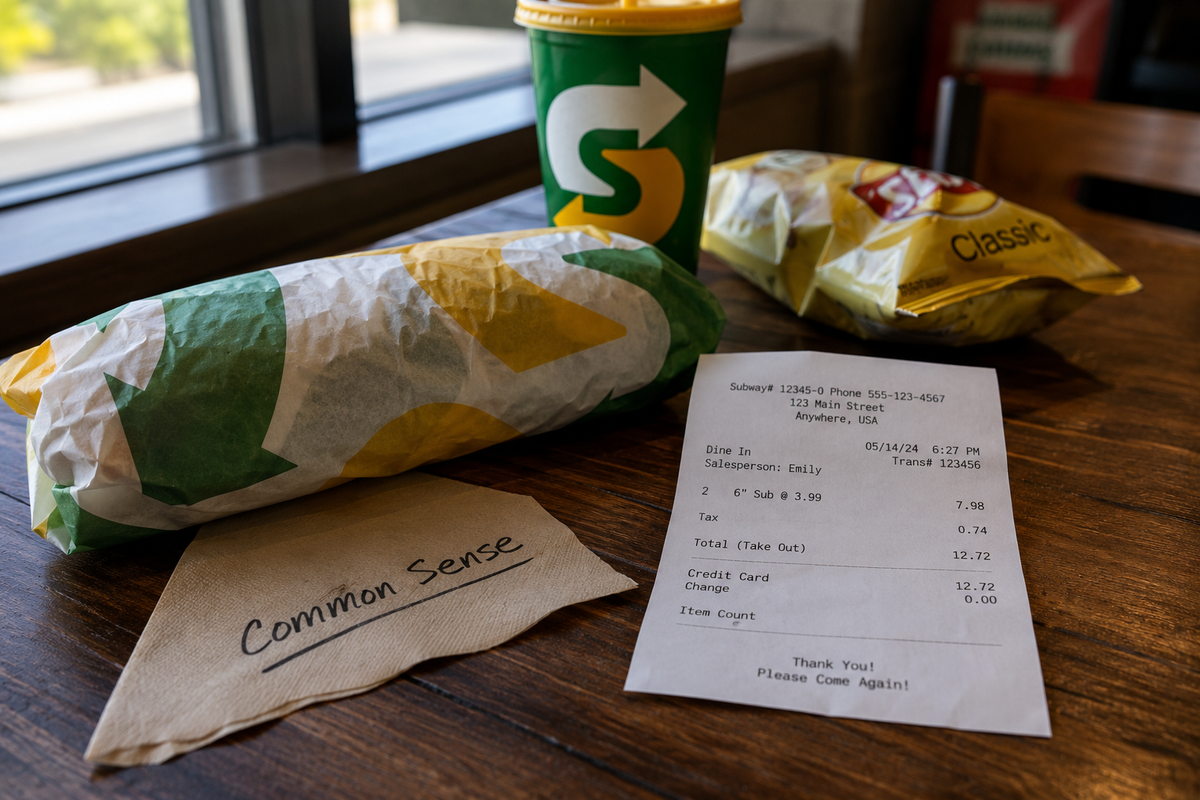
The Boss stopped at Subway the other night to grab dinner.
Now before anybody starts lecturing me about nutrition, let's save that discussion for another day. I know there are healthier options. There are probably healthier options than some of the things I've willingly eaten at county fairs. That's not the point of this story.
Subway was running a promotion on certain six-inch sandwiches for $3.99. The Boss saw the sign, decided that sounded like a reasonable deal, and ordered two six-inch sandwiches. Pretty straightforward. At least it would have been twenty years ago.
When she got to the register, the total came up around twelve dollars. Being the responsible guardian of our household finances, she politely pointed out that two sandwiches at $3.99 should not require the financial planning normally associated with purchasing a bass boat.
The young lady behind the counter explained the problem. Apparently somewhere during the ordering process, the words "footlong" had entered the conversation. The Boss wanted two six-inch sandwiches. The employee understood that. The Boss understood that. Anybody standing within fifty feet understood that.
Unfortunately, the cash register had reached a different conclusion.
The Boss explained she wanted two six-inch sandwiches, and the employee explained she had already pushed the button. The Boss explained again, and the employee explained the button again. At this point the button had apparently become the highest-ranking authority in the building. It outranked the customer. It outranked the employee. It may have outranked the franchise owner. For all I know, it outranked Congress.
The button had spoken.
Now, I've spent enough years in business to know exactly what should have happened next. Somebody should have smiled and said, "No problem. Let's fix it." Thirty seconds later everybody would have gone home happy.
Instead, we got a front-row seat to something I've been noticing more and more over the last several years. Common sense seems to be losing. Not occasionally. Regularly.
You see it everywhere. You call customer service and spend fifteen minutes talking to a phone system that keeps assuring you your call is important while simultaneously doing everything possible to avoid letting you speak to an actual human being. You stand at a self-checkout machine that's demanding approval from an employee because you placed a bag in the bagging area exactly where it told you to place the bag. You visit a website that requires seventeen passwords, three security questions, two verification codes, and a blood sample just to find out when your appointment is.
The people involved often know the answer. They know what should happen. They know what would solve the problem. But somewhere along the line, the system became more important than the outcome.
And that's where things get interesting.
Common sense has never really been about rules. It's always been about judgment. It's the ability to look at a situation, understand what's happening, and make a reasonable decision. For most of human history, that's how we operated. The waitress forgot to ring something up? Fix it. The customer made a mistake? Help them. The employee hit the wrong button? Correct it. Problem solved.
Today it sometimes feels like we've replaced judgment with procedure. We've become so dependent on systems that people are afraid to overrule them even when everybody in the room knows the system is wrong.
That's not a technology problem. That's a people problem.
Technology can be incredibly useful. I like technology. I use it every day. Half the reason you're reading this is because of technology. But somewhere along the way, we started treating technology like it's always right.
It isn't.
Anybody who's ever argued with a GPS knows that. A GPS will drive you into a lake with absolute confidence and never lose a minute of sleep over it. It won't apologize. It won't admit it was wrong. It'll simply recalculate and continue its mission to drown you.
The older I get, the more I think common sense might be one of the most valuable skills a person can have. Not intelligence. Not education. Not credentials. Common sense. The ability to recognize when the map and the road no longer match. The ability to say, "This doesn't make sense." The ability to fix a problem instead of explaining why the problem can't be fixed.
Maybe that's why it feels endangered.
Not because people are getting dumber. I don't think they are. I think we've simply built a world where common sense has to ask permission before entering the room.
And sometimes the button says no.
The good news is I still meet people every day who have it. The waitress who fixes a mistake before you notice it. The mechanic who tells you what actually needs repaired instead of what he could sell you. The teacher who understands every kid isn't the same. The customer service representative who finds a way instead of an excuse.
They're still out there, which gives me hope.
Because if common sense truly disappeared, we'd never be able to find it.
The GPS would just keep recalculating.