The $40,000 Mistake People Make Every Day
Most people spend more time researching a television than they do the financial decision behind a vehicle purchase. The biggest mistake isn't usually the car. It's everything that happens before the car.
The other night I'm sitting in my recliner watching TV when one of those car commercials comes on. You know the ones. There's a brand new SUV cruising down some mountain road that apparently nobody else in America has ever heard of. The sun's setting. Husband's smiling. Wife's smiling. Kids are smiling. Even the dog looks like he's having the best day of his entire life.
Meanwhile, back in reality, somebody's kid just dropped a chocolate milkshake in the back seat. Somebody else is digging around trying to find a phone charger. And Dad's pretending he doesn't hear that weird noise coming from under the car because he's terrified to find out what it's gonna cost to fix.
I've always wondered who these commercials are actually for. Not because they're not entertaining—they are. But after spending time in and around dealerships, I've noticed something. Most people think the biggest mistake they can make is buying the wrong vehicle. They obsess over it. Lose sleep over it. Spend months researching like they're writing a dissertation on pickup trucks.
Here's the thing: they're worried about the wrong part. The vehicle usually isn't the mistake at all.
Let me tell you about this customer I had a few years back. Guy comes in looking for a truck. Smart guy. Real smart. The kind of guy you'd want on your trivia team because he knows a little bit about everything. For almost an hour, he tells me about the truck he wants. He knows the horsepower. He knows the towing capacity. He knows which engine people love and which one starts making weird noises at 80,000 miles. He knows which model year had the transmission problems—the ones that caused all those lawsuits and angry internet posts—and which year they fixed it. He knows what YouTube says, what the forums say, probably what the engineers were thinking when they designed the thing.
By the time he's done talking, I'm pretty sure if the factory called him up that afternoon, he could walk in and help build the damn truck.
Then I ask him a simple question. Not a trick question. Not one of those dealership questions people think are designed to screw them over. Just a normal question I ask everybody: "What payment are you comfortable with?"
He looks at me. Then he looks at the truck. Then he looks back at me. You'd think I just asked him to explain quantum physics. This guy—this smart, detail-oriented guy—spent six months researching every spec on this truck and basically zero time thinking about the financial decision he's about to make. He can tell me the gear ratios, but he's got no idea what he can actually afford.
Now before anybody starts laughing at this guy, I've done the same thing. Not with cars necessarily, but with plenty of other stuff. I've spent hours researching products that cost less than dinner at Texas Roadhouse. Read reviews from people with usernames like "TruckNut47" who probably aren't entirely stable. Watched YouTube videos where some guy spends forty-five minutes explaining why one brand of screwdriver is better than another. Dug through comment sections where strangers spend entire weekends arguing about lawn mowers and whether motor oil brands are plotting against America.
We're funny that way. We'll research a two-hundred-dollar purchase like we're preparing for trial, then turn around and drop forty grand on something because the blue one looked nicer than the red one.
And honestly, part of this is on us as a society. Nobody teaches this stuff. School taught me algebra. I vaguely remember solving for X, though I haven't seen X in years and I'm starting to think he moved without telling anyone. What would've been useful? A class on interest rates. Credit scores. Depreciation. Why a payment that feels fine today can start choking you after life happens.
Because life always happens. That's what nobody tells you when you're signing papers and everything feels great.
Cars break. Kids need braces. The water heater quits, usually right when you think you're finally getting ahead. The dog eats something and you end up at the vet who apparently charges by the heartbeat. Life's got this talent for showing up with a bill right after you've convinced yourself everything's under control.
That's why I hate the question "What can I get for five hundred a month?" I've heard it thousands of times. Sounds reasonable, right? Problem is, a payment's just a number. It can be stretched and squeezed and manipulated until it looks like something completely different. A monthly payment is one piece of the puzzle, and people are trying to start with the last piece. It's like buying a house because you liked the curtains.
The truck guy eventually figured it out. Most people do. Once we started talking about his actual budget, his goals, how long he's keeping the vehicle, what happens if life throws him a curveball—the conversation got easier. And here's the funny part: he ended up buying a different truck than the one he came in for. Not because I talked him into it. Because the math talked him into it. Once he understood what he could actually afford—not just "the bank will approve this" but "I can make this payment for five years without my life falling apart"—the decision was obvious.
Math does that. It cuts through all the emotion and shows you what's real.
In all my years doing this, I've learned one thing: math is undefeated. You can ignore it. Argue with it. Pretend it doesn't apply to you. Math doesn't care. The bank doesn't care how bad you've wanted a truck since high school. The interest rate doesn't care that your neighbor just bought one. The payment doesn't care how good it looked under the showroom lights.
Math just waits. And eventually it wins.
That's why the biggest mistake isn't buying the wrong vehicle. It's buying before you understand the numbers. Wrong vehicle? You can trade it. Bad financial decision? That thing's gonna sit in your driveway long after the new-car smell's gone, reminding you every month that you screwed up.
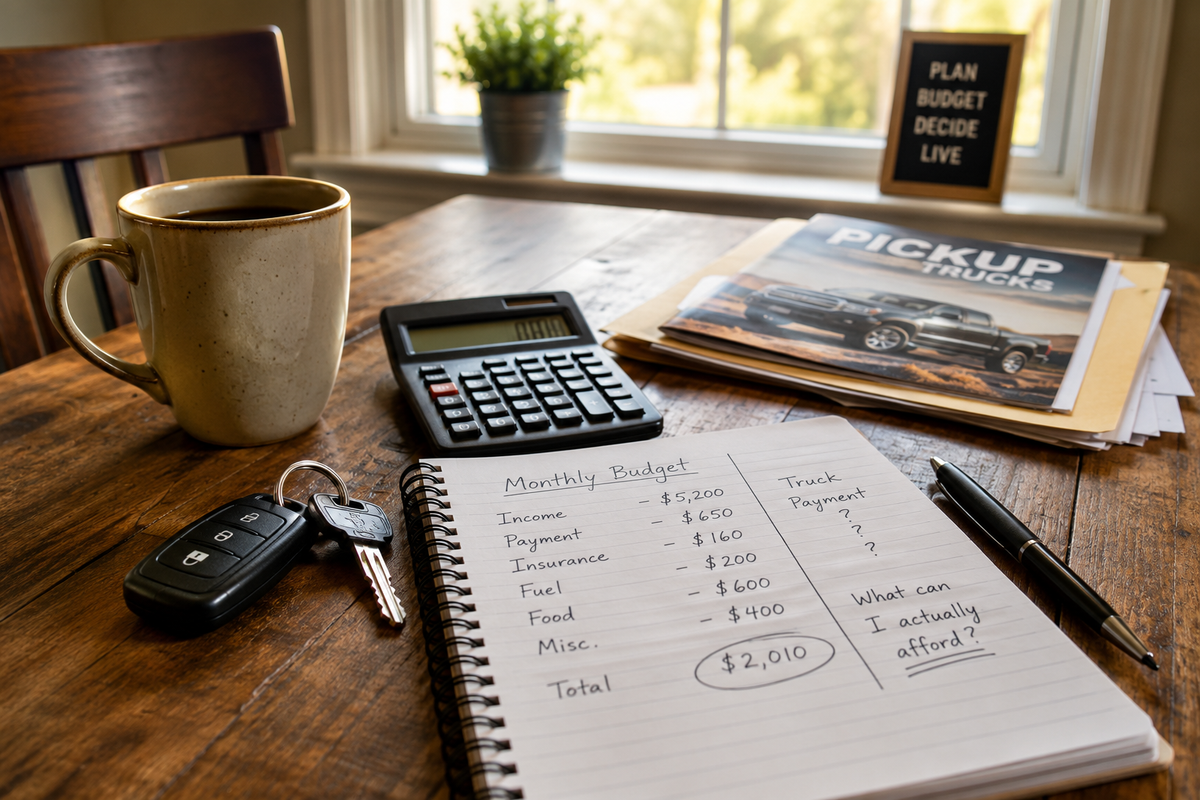
And that's what the commercials never show. They show the mountain road. The sunset. The happy family. What they don't show is the kitchen table six months later when somebody's looking at the bank statement at two in the morning, wondering where all the money went, realizing the payment they thought they could handle is crushing them.
That's not as exciting as a shiny truck on a mountain road. But it's a hell of a lot closer to real life.